The Silent Efficiency Killer
Solar panels are built to withstand decades of sun, wind, and rain — but the one thing they can't defend themselves against is what settles on the glass. Dust, bird droppings, pollen, industrial soot, and airborne sand form a fine film across the module surface that scatters and blocks incoming sunlight before it ever reaches the cells beneath.
Industry studies show that soiled panels can lose up to 25% of their energy yield if left unwashed for extended periods. Unlike a mechanical fault or an inverter trip, soiling doesn't announce itself with an alarm or an error code — it simply, quietly, reduces the return on every rand invested in the system.
Why Dust Is a Uniquely African Challenge
Africa's climate and geography make soiling a bigger and more variable problem than in many other solar markets. A handful of conditions combine to accelerate the build-up of grime on panel surfaces:
- Long dry seasons with little natural rainfall to rinse panels
- Highveld and mining-belt dust from open-cast operations and tailings
- Wind-blown Kalahari and Sahelian sand across arid and semi-arid regions
- Agricultural dust from tilled land and harvest season activity
- Bird activity around rooftop and ground-mount arrays
- Coastal salt spray that combines with dust to form a stickier film
- Industrial and urban particulate near commercial and factory sites
- Pollen loads during seasonal flowering periods
In many parts of Southern Africa, six or more months can pass between meaningful rainfall events. On a system left to fend for itself over a dry Highveld winter, soiling can accumulate steadily with nothing to interrupt it — turning a manageable seasonal dip into a significant, compounding revenue loss.
The Science Behind Soiling Loss
Soiling doesn't just block a proportional amount of sunlight — its impact on output is often disproportionate to the area it covers. A few mechanisms are at play:
Light transmittance loss. Even a thin, seemingly light layer of dust scatters and absorbs incoming irradiance before it reaches the photovoltaic cells, reducing the energy available for conversion.
Uneven soiling and cell mismatch. Dust rarely settles evenly. Panels are more exposed at the base than the top, and localized patches — like bird droppings or leaf debris — create unevenly shaded cells within a string. Because cells in a string are wired in series, a handful of heavily soiled cells can drag down the output of an entire string, not just the shaded area itself.
Hotspot risk. Persistent partial shading from soiling forces bypass diodes to activate more frequently, and in severe cases can create localized heating ("hotspots") that stress cells and shorten module lifespan over time.
Quantifying the Impact
Soiling loss varies significantly by region, season, and site conditions, but the pattern is consistent: the longer panels go without cleaning in a dusty environment, the steeper the decline.
- Coastal or high-rainfall sites: typically 2 – 6% loss between natural rain-cleaning cycles
- Highveld and inland commercial sites: often 8 – 15% during extended dry spells
- Mining-adjacent, agricultural, or high-dust arid sites: can reach 20 – 25% or more without intervention
These losses compound month over month during the dry season, meaning a system that looks perfectly healthy on a site walk-through can still be quietly underperforming its design yield by a wide margin.
The Financial Cost of Doing Nothing
Consider a 1 MWp commercial rooftop system generating an expected 1,600 MWh annually. A sustained 15% soiling loss during a six-month dry season translates into roughly 120 MWh of lost generation — energy that was paid for through the capital investment but never delivered to the meter. At typical commercial electricity tariffs, that's a meaningful, recurring loss that erodes payback periods and reduces the lifetime return on the asset.
Unlike equipment failures, soiling losses are entirely preventable. A scheduled cleaning programme is one of the highest-ROI maintenance activities available to a solar asset owner, because the cost of cleaning is consistently a fraction of the revenue it recovers.
How Often Should Panels Be Cleaned?
There is no single correct answer — cleaning frequency should be matched to the site's environment, not applied as a blanket rule. As a general guide:
- Low-dust, high-rainfall sites: 1 – 2 cleans per year
- Typical commercial and Highveld sites: quarterly cleaning
- High-dust, mining, agricultural, or coastal-salt sites: every 4 – 6 weeks during dry periods
The right frequency ultimately comes down to a proper site assessment, combined with performance monitoring that flags soiling-related output dips as they emerge — rather than waiting for a scheduled visit to discover the loss after the fact.
Beyond Cleaning: Catching Soiling Early
The most effective soiling management pairs physical cleaning with continuous performance monitoring. Remote telemetry and string-level analytics can detect abnormal output dips that correlate with soiling well before the loss becomes severe, allowing cleaning crews to be dispatched proactively rather than on a fixed calendar. This data-driven approach ensures cleaning budgets are spent where and when they matter most, instead of over-cleaning low-risk sites or under-cleaning high-risk ones.
How Solarev Approaches Soiling Management
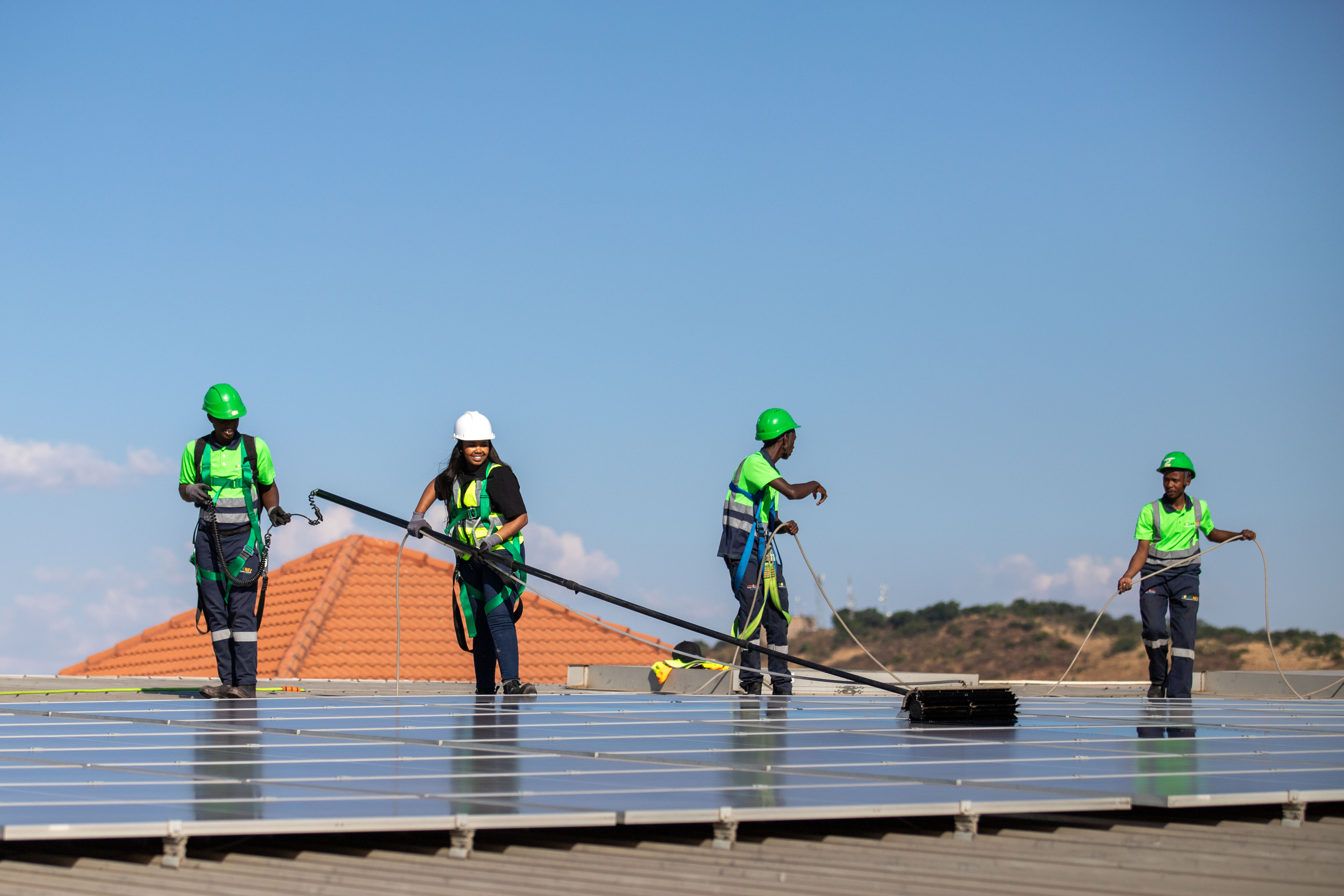
Our cleaning teams use purified soft water and non-abrasive brushes to restore panel performance without risking the mechanical or optical integrity of the module surface, following manufacturer-approved protocols to keep warranty coverage intact. Every clean includes a visual inspection, before-and-after photo documentation, and a maintenance report, so asset owners have a clear, auditable record of the performance recovered.
For sites where soiling risk is high or variable, we combine scheduled cleaning with our remote monitoring and performance analytics services, giving asset owners a full picture of how soiling is affecting output between visits — and the data to justify adjusting cleaning frequency where it counts.